
Welcome to HTP analysis & statistics platform !
Haplotype-tag polymorphisms (HTP) is a high-resolution, high-efficient, and low-cost molecular marker which can serve as a low cost, time, and high-throughput genotyping resources for genetic mapping, germplasm resource analysis and genomics-informed breeding in maize. This platform is an open source web server and free software that fully support HTP mark with comprehensive analysis include crossing pattern in maize heterosis and DNA fingerprint analysis.
Development of genome-wide HTPs
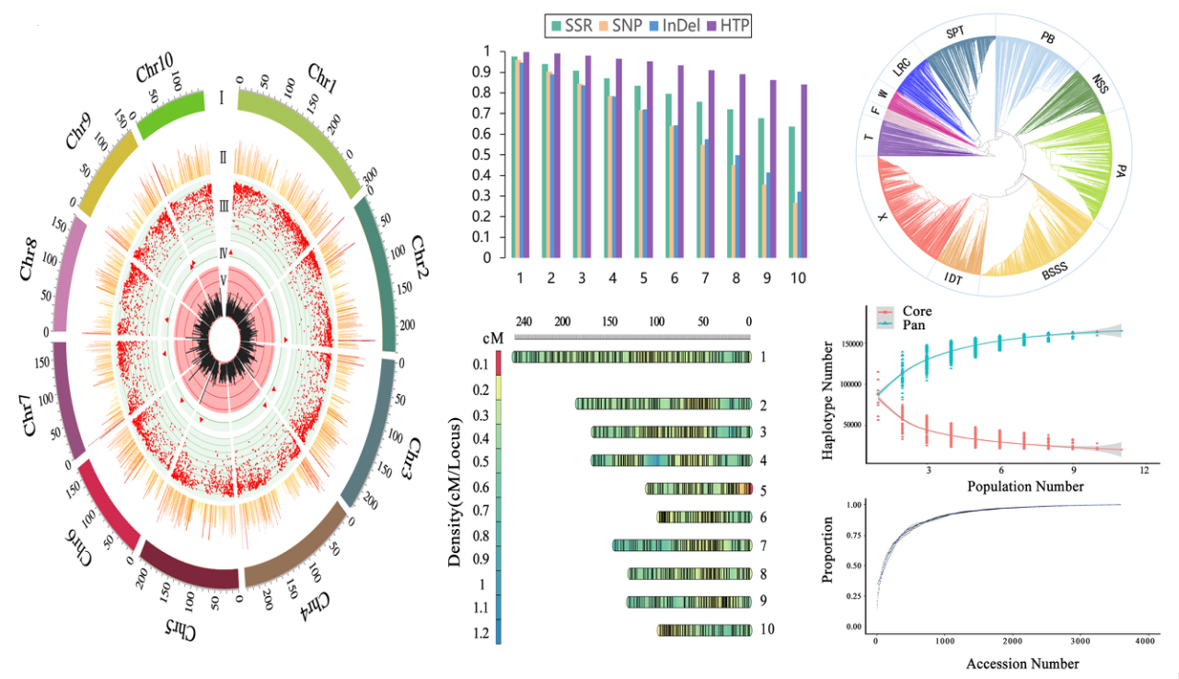
An HTP-based analytical strategy can divide the whole genome into blocks with haplotype tags during analyses of the genomic background of germplasm resources. The core aspect of an HTP-based analytical strategy involves the integration of the available information regarding the whole genome of tens of thousands of samples and the subsequent analysis using haplotype tags. A survey of all HTPs in the maize B73 reference genome revealed that our 6,163 nuclear HTPs were evenly distributed in the whole genome and were highly polymorphic. Each HTP contained several SNPs and InDels. Among the 6,163 HTPs, 2,811 had more than 10 variations (SNPs and InDels combined). Additionally, our HTPs were highly informative. More specifically, 5,549 of the markers had a polymorphism information content (PIC) value exceeding 0.5, and 576 had a PIC value greater than 0.9. Furthermore, regarding their polymorphism, 811 HTPs had more than 50 allelic variation (haplotypes), and 12 HTPs had more than 100 allelic variation.
Pedigree reconstructions
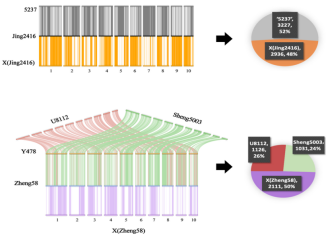
The frequent gene flow between diverse breeding populations has resulted in complex genomic backgrounds in maize varieties used for breeding. Additionally, certain breeding methods, such as selfing, distant hybridization, and multi-generation backcrossing, may lead to the production of inbred lines with relatively unclear pedigrees. The available traditional molecular markers are useful for clarifying paternity and identifying varieties. However, the methods used for characterizing inbred materials that span multiple generations (e.g., inferring the parents of ancestors) have yet to be effectively and widely implemented for maize (Howard et al., 2021). Therefore, we developed a method that supports complex pedigree reconstructions via the genome-wide HTPs and HTPtools along with the maize HTP database (from 3,578 accessions).
DNA fingerprint analysis
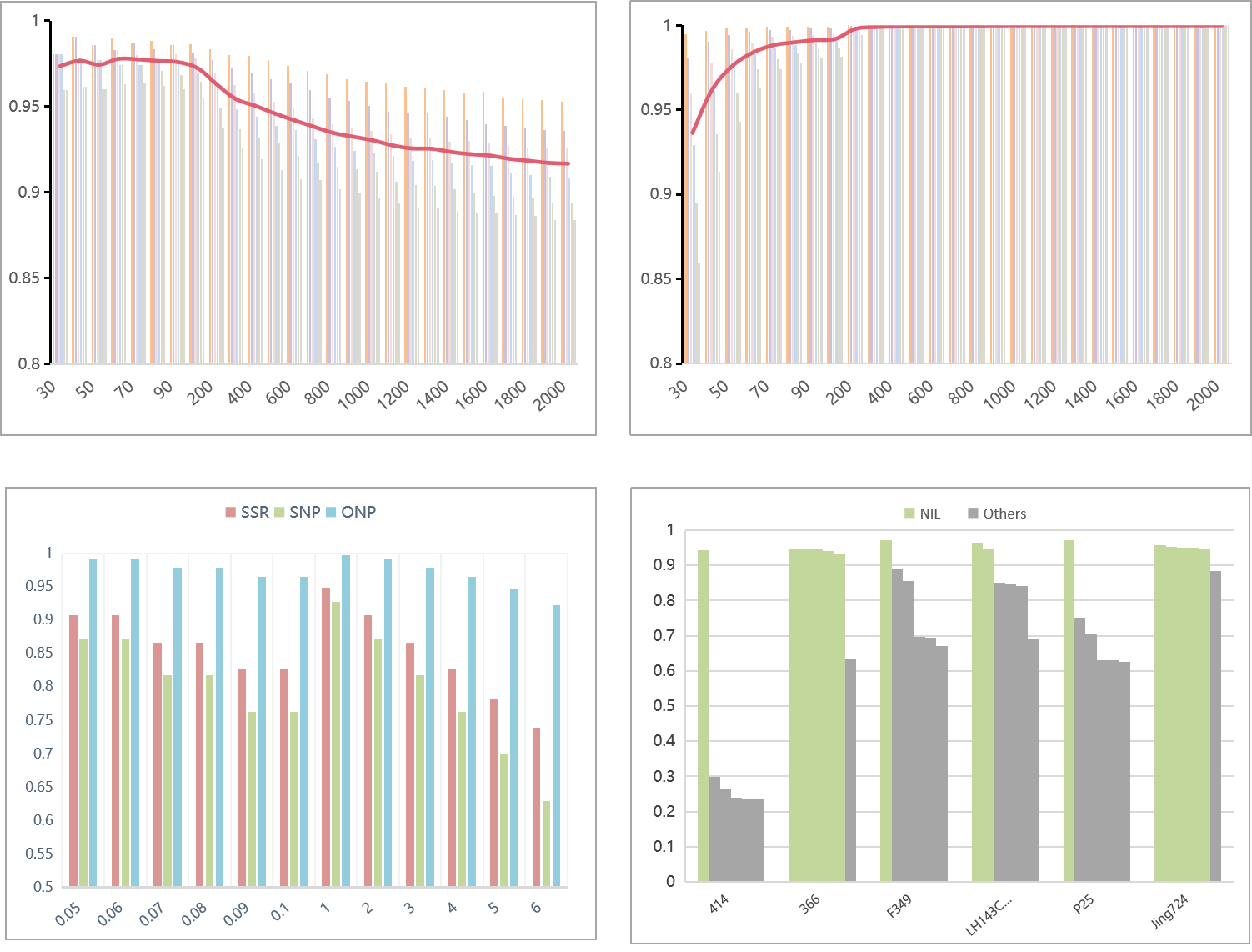
A single HTP or a few HTPs may be selected as independent molecular markers for identifying varieties, which may be relevant for protecting intellectual property rights. THe online analysis and HTPtools had integratesd the “Data comparison” function which integrates an efficient genome-wide haplotype comparison algorithm and an HTP comparison algorithm (inbred line and hybrid). We also compared the variety discrimination power of SNPs, SSRs, InDels, and HTPs using VDPtools. Our results indicated that the HTPs were better for distinguishing between maize varieties than the other three molecular markers, making them potentially useful for protecting crop-related intellectual property rights.

HTP haplotype database
We constructed a haplotype phased block map. Using 3,587 inbred lines, we finished the imputation of the haplotype of HTP markers. At the same time, a haplotype database of HTP was generated. Subsequently, we conducted a comprehensive statistics on 6163 HTPs, and generated a statistical table of HTP information, including the number of markers, allelic variation, PIC, genetic distance, Block size, etc. In addition, we also developed an HTP marker on the chloroplast, which contains 65 SNPs and 3 InDels. Finally, we obtained 6,164 HTP markers including 6163 HTP on nuclear chromosomes and 1 HTP on chloroplast. At the same time, we also calculated Tag SNP for each HTP through the Haploview tool and recorded it in the haplotype database which is convenient for researchers to inquire and analysis. HTP's complete haplotype database and HTP information statistics table can be accessed from the following address and can be downloaded for free:https://htp.plantdna.site/nucleus-haplotype andhttps://htp.plantdna.site/nucleus-overall.
- HTP online version 1.0 is publicly accessible. (2021-05-10)
- HTP tools online. (2021-05-20)
- Tian H, Yang Y, Yi H, Xu L, He H, Fan Y, Wang L, Ge J, Liu Y, Wang F, Zhao J. New resources for genetic studies in maize (Zea mays L.): a genome-wide Maize6H-60K single nucleotide polymorphism array and its application. Plant J. 2021; 105, 1113-1122.
- Li C, Li Y, Bradbury PJ, Wu X, Shi Y, Song Y, Zhang D, Rodgers-Melnick E, Buckler ES, Zhang Z, Li Y, Wang T. Construction of high-quality recombination maps with low-coverage genomic sequencing for joint linkage analysis in maize. BMC Biol. 2015; 13: 78.
- Yang Y, Tian H, Wang R, Wang L, Yi H, Liu Y, Xu L, Fan Y, Zhao J, Wang F. (2021) Variety Discrimination Power: An Appraisal Index for Loci Combination Screening Applied to Plant Variety Discrimination. Front Plant Sci. 12: 566796.
- Maize Research Center, Beijing Academy of Agriculture & Forestry Sciences (BAAFS), Beijing Key Laboratory of Maize DNA Fingerprinting and Molecular Breeding, Shuguang Garden Middle Road No. 9, Beijing 100097, China
- Institute of Crop Sciences, Chinese Academy of Agricultural Sciences, Beijing 100081, China
- Jilin Academy of Agricultural Sciences, Maize Research Institute, Gongzhuling 136100, China
- Provincial Key Laboratory of Agrobiology, Institute of Crop Germplasm and Biotechnology, Jiangsu Academy of Agricultural Sciences, Nanjing 210014, China
- College of Agronomy and Biotechnology,China Agricultural University, Beijing 100193, China
- College of Advanced Agriculture and Ecological Environment, Heilongjiang University, Harbin 150080, China